 Beyond Coordinates
3D Gaussian Splatting (3DGS) is rapidly becoming a mainstream representation for photorealistic 3D rendering on the web. The industry has not yet converged on how a browser should efficiently stream and render millions—or tens of millions—of splats. This article compares two representative open-source approaches, Cesium 3D Tiles + glTF KHR_gaussian_splatting and SparkJS 2.0, examining their data formats, LOD strategies, streaming pipelines, runtime memory, ecosystem integration, and design tradeoffs.
Cesium and SparkJS solve the same problem from opposite directions:
- Cesium treats Gaussian splats as a standard payload within 3D Tiles. 3D Tiles supplies spatial indexing, metadata, and the request model;
KHR_gaussian_splattingdefines splat semantics; and the current implementation also requires an SPZ compression extension. - SparkJS 2.0 treats splats as a renderer-native data structure. It uses a custom Gaussian tree for LOD, a fixed global splat budget, a virtualized GPU page table for residency, and its own
.radformat for chunked streaming.
Choose Cesium for open standards, georeferencing, 3D Tiles metadata, and integration with large geospatial scenes. Choose SparkJS for strict control over the active splat count, fine-grained paging, low working-set memory, and tight Three.js integration.
Architecture and Data Formats
Cesium: A Layered Standards Stack
Cesium uses a layered stack. The outer layer is a 3D Tiles tileset: every tile has a bounding volume, geometric error, refinement mode, and content URI. With implicit tiling, subtree files index the hierarchy, availability bitstreams use Morton order, and property tables can attach metadata.
Each selected tile contains glTF or GLB. Splats are point primitives with POSITION, KHR_gaussian_splatting:ROTATION, SCALE, OPACITY, and spherical-harmonic coefficients, plus optional COLOR_0 data for a point-cloud fallback.
CesiumJS cannot currently render arbitrary glTF splats. It checks that the tileset declares both KHR_gaussian_splatting and KHR_gaussian_splatting_compression_spz_2. Selected tiles are expanded into runtime arrays—positions, rotations, scales, colors, and packed SH—and then aggregated into one rendering snapshot. Therefore:
Cesium’s streaming unit is the tile, and its runtime organization is structured CPU arrays followed by GPU texture packing.
SparkJS: Two Renderer-native Storage Layers
Spark uses two storage layers.
Layer 1, PackedSplats: the core layout is fixed at 16 bytes per splat: float16 center coordinates, a 3-byte logarithmically encoded scale, 4-byte RGBA, and an octahedral-plus-angle compressed quaternion. SH is stored separately (sh1 uses two words per splat; sh2 and sh3 use four each). This is a hybrid of an AoS 16-byte core record and SoA side buffers for SH.
Layer 2, .rad: introduced in Spark 2.0 for LOD, streaming, and random access. It supports custom field encoding, columnar storage, compression, and chunked random access. At runtime, Spark either performs byte-range requests against one .rad file or follows header references to external .radc chunks. Page size is fixed at 65,536 splats per page, and the shared desktop GPU pool defaults to 16,777,216 splats.
Different Roles for SPZ
SPZ, Niantic’s open-source Gaussian compression format, matters to both ecosystems but serves different roles. For Cesium, SPZ is the compression path in the glTF extension workflow. For Spark, it is only one input format; .rad is the native streaming format for large LOD scenes. SPZ is an interchange and transport codec, while .rad is a runtime-oriented scene-delivery codec.
Format Comparison
| Property | Cesium 3D Tiles + glTF | SparkJS 2.0 |
|---|---|---|
| Primary container | 3D Tiles tileset + glTF/GLB content; hierarchy, metadata, and availability come from 3D Tiles | PackedSplats + .rad/.radc for prebuilt streaming LOD scenes |
| Data organization | glTF point attributes → runtime arrays → aggregated snapshot | 16-byte packed core record + separate SH buffers; columnar, chunkable .rad storage |
| Quantization/compression | glTF permits float or normalized integer accessors; Cesium currently requires SPZ | Fixed-width quantized core, bit-packed SH, and compressed chunked access in .rad |
| Metadata/indexing | Tile/content metadata, implicit-subtree availability, Morton ordering | Header metadata, chunk-to-page mapping, freelist, and LRU |
| Streaming unit | Tile-content and subtree files | Network chunks and GPU pages of 65,536 splats |
| Standardization | Open-standards path; KHR_gaussian_splatting is a Release Candidate proposed for 3D Tiles 2.0 | Open source but Spark-specific; not an industry standard |
LOD: Tile-level Error vs. a Splat-tree Budget
This is the most fundamental difference between the two systems.
Cesium: Tile-level Screen-space Error
Cesium inherits its LOD model from 3D Tiles. Every tile has a geometricError and a REPLACE or ADD refinement mode. Runtime screen-space error is derived from geometric error and camera state, and refinement occurs above a threshold. The LOD unit is a tile, and the metric is tile-level screen-space error—not individual-splat importance.
Spark: Gaussian Splat Tree with a Hard Budget
Spark constructs a Gaussian splat tree in which every internal splat is a downsampled representation of its children. Background traversal uses a priority queue ordered by pixel_scale, the projected angular size. Refinement stops when the largest frontier splat is smaller than one pixel, the node has no children, or further refinement would exceed budget N. Multi-tree traversal and foveation distribute the global budget across objects according to screen relevance.
Cesium asks, “Which spatial tiles should be displayed?” Spark asks, “Which splat-tree frontier produces the best image under this budget?”
This distinction determines most downstream behavior. Cesium’s coarse unit provides interoperability and metadata support, but refinement quality depends on the tiler’s spatial partitioning and geometric-error assignment; the Cesium ion tiler is not open source. Spark directly controls complexity and detail distribution, with O(N log N) traversal cost relative to rendered splats rather than total scene size, but only within Spark’s ecosystem.
Streaming Pipelines
Cesium: Select Tiles → Aggregate a Snapshot → Commit Atomically
- 3D Tiles traversal selects visible tiles.
GltfLoaderloads content;GaussianSplat3DTileContentextracts and caches positions, rotations, scales, and SH.GaussianSplatPrimitiveaggregates selected tiles into a pending snapshot.- A WASM texture generator packs attributes into GPU textures.
- A WASM radix sorter produces the sorted index buffer, and the snapshot is committed atomically.
- In steady state, sorting runs again only after camera movement exceeds a threshold.
Spark: Operating-system-style Virtual Memory
PagedSplatsparses the.radheader from a small leading byte range, expanding from 64 KB to 256 KB and then 1 MB as needed.- It obtains chunks through byte-range requests or external
.radcfiles and decodes them in a worker. SplatPagermanages a shared page pool, freelist, LRU, chunk-to-page mapping, and preallocated textures.- Visible instances upload an index-indirection texture mapping logical output order to page-resident packed splats.
This applies operating-system-style virtual memory to splats: streaming unit = chunk, residency unit = page, draw-indirection unit = index texture.
Spark’s pager is not yet fully mature. Open issues report that disposing PagedSplats does not abort in-flight requests, orphaned requests can leave stale references in pager maps, and .rad scenes can exhibit animation stutter. These issues do not invalidate the architecture, but they matter when selecting a production path.
A Shared Abstract Lifecycle
Both pipelines share the same abstract lifecycle: a selector decides what is needed → the network retrieves a tile or chunk → a worker or WASM module decodes it → textures and indices are uploaded → splats are sorted and drawn.
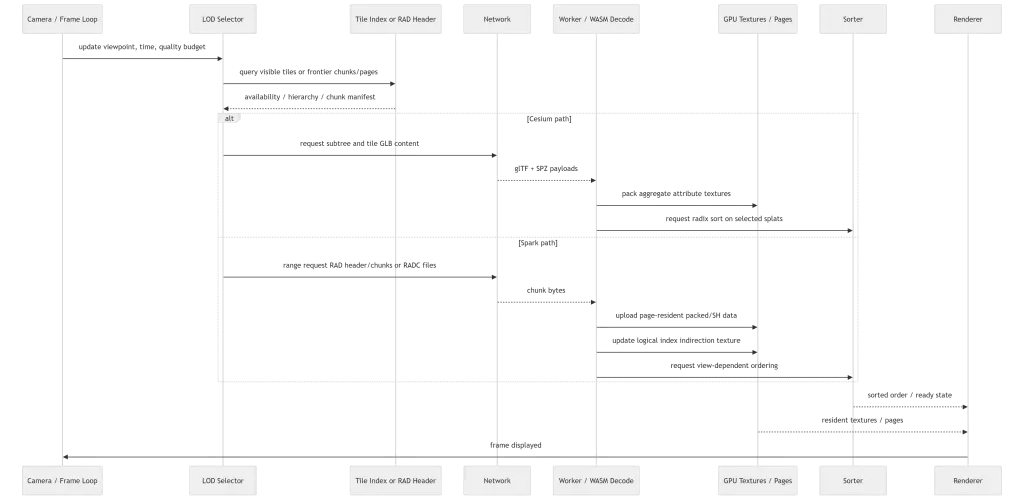
Runtime Memory and GPU Layout
Both public implementations are WebGL-first and texture-centric, but their working-set memory costs differ significantly.
Cesium: CPU-side positions, rotations, and scales use Float32Array; colors use Uint8Array; and SH half-float pairs are packed into Uint32Array. Each GPU splat occupies two RGBA32UI texels, or 32 bytes, in the primary attribute texture, with SH in another integer texture. Rendering disables culling, enables depth testing, disables depth writes, and uses premultiplied-alpha blending.
Spark: an RGBA32UI DataArrayTexture stores the 16-byte packed core record. RG32UI and RGBA32UI textures store SH, while PagedSplats adds a 2D RGBA32UI index texture for logical indirection. Sorting can use radial distance or z-depth. The documentation recommends disabling browser MSAA, which does not improve splatting and reduces performance.
Storage and Working-set Estimates
| Metric | Cesium | SparkJS 2.0 |
|---|---|---|
| Source bytes/splat, core only | Estimated 24–36 B; SPZ can substantially reduce disk size | Exactly 16 B |
| Source bytes/splat, with SH3 | Estimated ~228 B with all-float32 SH | Exactly 56 B: 16 core + 8 sh1 + 16 sh2 + 16 sh3 |
| Active GPU bytes/visible splat, core only | ~32 B: two RGBA32UI texels | ~20 B: 16 core + ~4 index |
| Active GPU bytes/visible splat, with SH3 | ~152 B | ~60 B |
| Decode/staging model | Tile decode + transform + snapshot aggregation + texture packing + sort | Worker chunk decode + page upload + index update + sort |
(Spark’s core values are exact. Cesium’s byte counts are estimates because glTF accessors permit several component types and SPZ substantially changes disk size.)
Cesium’s hard-limit behavior is also notable. If the packed-splat texture would exceed the maximum texture dimensions, the implementation truncates the visible splat count and temporarily increases screen-space error. If the SH texture exceeds its limit, SH is disabled for that snapshot and rendering falls back to colors only. Cesium’s visible-splat renderer is therefore constrained mainly by texture capacity for the current tile set, not by a fixed application-level budget.
Performance Characteristics and Tradeoffs
Bandwidth: Cesium reduces network complexity through a standard hierarchy: subtree availability tells the client which tiles exist before fetching. Once selected, however, the request unit remains an entire tile-content file. Spark pays for a custom transport contract but fetches only the chunks required to fill the current budget frontier and reuses one fixed GPU pool across objects.
CPU: Cesium’s heavy work occurs when the selected tile set changes: aggregation, transformation, packing, and sorting. Its architectural unit is “rebuild the visible snapshot.” Spark shifts work into continuous background maintenance—priority-queue traversal, chunk decoding, page residency, and index updates—avoiding a monolithic rebuild after small view changes.
GPU: Spark’s advantage is clearest when the scene is enormous but screen complexity is bounded. Its fixed budget makes rendering cost nearly independent of total scene size: roughly 1.5 million LOD splats by default on desktop and 500,000 on mobile. Cesium’s screen-space-error mechanism is excellent for general 3D Tiles refinement but less direct as a Gaussian-specific budget.
Mobile: Spark provides a clearer budget model. Its paged-splat pool defaults to roughly 6.29 million splats on iOS and 8.39 million on other mobile devices, versus 16.78 million on desktop, and it exposes foveation controls. Cesium’s fallbacks are robust but opportunistic—truncate on overflow or disable SH. Spark fits better when device-level predictability matters more than standards alignment.
Decision Table
| Property | Cesium 3D Tiles + glTF | SparkJS 2.0 |
|---|---|---|
| Format | Open-standards path, currently requiring SPZ compression | Open source but Spark-specific; .rad is not an external standard |
| LOD unit | Hierarchical tile | Gaussian-tree node |
| Streaming unit | Tile-content and subtree files | Network chunk and GPU page |
| Bytes/splat | Higher and more variable: GPU core ~32 B, ~152 B with SH3 | Lower and predictable: exactly 16 B core, ~60 B with SH3 |
| Decode cost | Bursty when the tile set changes | Incremental worker, paging, and index updates |
| Greatest strength | Standards, geospatial metadata, interoperability, multi-engine deployment | Fixed-budget rendering, fine-grained streaming, low active memory, native Three.js integration |
| Greatest weakness | Coarse request granularity and expensive snapshot rebuilds | Weak transport standardization; pager and animation still have rough edges |
| Best fit | Geospatial digital twins, inspection systems, analytical overlays, mixed 3D Tiles scenes | Web/XR viewers, interactive worlds, and tightly budgeted composite scenes |
Choosing Between Them
If the project must live in the Cesium, 3D Tiles, and geospatial stack, choose Cesium. The deciding factor is not raw performance but organizational leverage: standard metadata, an existing toolchain, georeferencing, and deployment across CesiumJS and Unreal.
If the project is a custom web renderer and you control the viewer, content pipeline, and network protocol, choose Spark. A fixed active-splat budget and virtualized page-resident pool give it a clear advantage in client-side control and device-level predictability.
Future Directions
Standards momentum favors Cesium. KHR_gaussian_splatting is a Khronos Release Candidate whose design leaves room for future kernels, projections, and sorting modes. Cesium has also positioned splats as part of a future 3D Tiles proposal. Once splats become a durable open payload in glTF and 3D Tiles, every incremental ecosystem improvement will benefit splat delivery.
Spark’s contribution is architectural. It demonstrates that a Gaussian-native runtime can treat splats as a virtualized working set rather than one monolithic point cloud. Even if .rad never becomes a standard, fixed budgets, page tables, multi-tree frontier selection, foveation, and chunked random access are likely to influence future systems, including standard payload extensions and WebGPU-compute runtimes.
Open questions: the public .rad specification remains thin; the final Khronos name for the companion SPZ extension is still changing; and neither ecosystem has a public, strictly apples-to-apples benchmark suite using the same scene, SH degree, sorting mode, and device budget. The most defensible conclusion is architectural rather than benchmark-driven:
Cesium optimizes standardized geospatial streaming; Spark optimizes renderer-controlled splat virtualization.