 Beyond Coordinates
Introduction
This article records the implementation of a small thread pool based on concepts from cppcoro. The design is reimplemented and reduced to its essentials to expose the most important coroutine mechanics.
The diagram illustrates the difference between an ordinary procedure and the more general coroutine model. Adding suspension and resumption makes abstractions such as thread pools, state machines, and generators more direct and efficient.
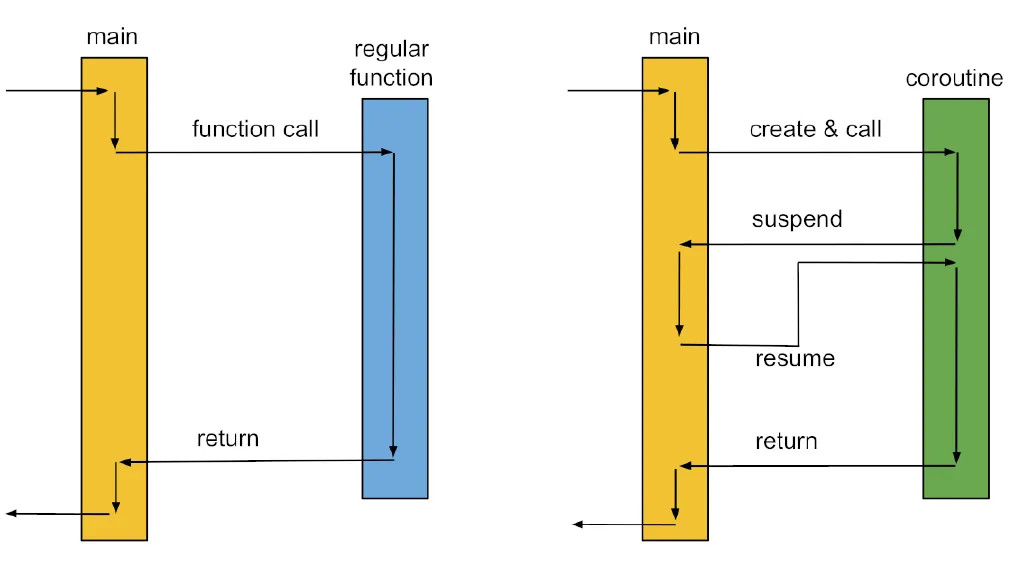
That flexibility introduces lifecycle concerns. Local state must survive suspension in a separately allocated coroutine frame and be restored on resumption; the frame must eventually be destroyed. The compiler generates this machinery. C++20 uses stackless coroutines, in contrast to stackful implementations such as Boost.Context that switch an entire stack. Stackful coroutines require no language changes, but stackless frames can use orders of magnitude less memory.
C++20 exposes the stackless model through several concepts and customization points, which the thread-pool implementation will demonstrate.
Fundamentals
A Coroutine
A coroutine looks much like an ordinary function, but its return type must meet the coroutine requirements and its body must contain at least one of co_await, co_yield, or co_return. This test coroutine schedules itself on the pool and prints the worker thread ID after resumption:
task run_async_print(threadpool& pool)
{
    co_await pool.schedule();
    std::cout << "This is a hello from thread: "
        << std::this_thread::get_id() << "\n";
}
co_await suspends the coroutine. Its operand must be awaitable, or convertible to an awaitable, and ultimately produces an awaiter. The awaiter defines whether suspension occurs, what happens during suspension, and what value is produced on resumption. Here it hands the suspended coroutine to the thread pool. The coroutine’s task return object lets its caller interact with the operation, obtain a result, wait for completion, and eventually destroy the coroutine frame.
Return Object and Promise Type
Before implementing the awaiter and pool, consider the return object and its associated promise type. task is the caller-facing handle, while task_promise is the interface used by compiler-generated coroutine code.
struct task_promise
{
    task get_return_object() noexcept {
        return task{ std::coroutine_handle<task_promise>::from_promise(*this) };
    };

    std::suspend_never initial_suspend() const noexcept { return {}; }
    std::suspend_never final_suspend() const noexcept { return {}; }

    void return_void() noexcept {}

    void unhandled_exception() noexcept {
        std::cerr << "Unhandled exception caught...\n";
        exit(1);
    }
};
task_promise controls creation and completion behavior. initial_suspend determines whether the coroutine begins executing immediately or starts suspended until its first explicit resumption. A lazy generator normally returns std::suspend_always; this initial thread-pool version returns std::suspend_never so execution reaches the scheduling co_await as soon as the task is created. This choice will change later.
final_suspend determines whether a completed coroutine suspends one final time or destroys itself. The first version chooses automatic destruction with std::suspend_never.
get_return_object creates the task and passes it a std::coroutine_handle used for later resumption. return_void handles both falling off the end and an explicit value-less co_return; unhandled_exception handles exceptions escaping the body.
co_return and co_yield are specialized coroutine operations built around the same suspension machinery. A generator, for example, yields a value, suspends, and resumes when the caller requests the next item. See cppcoro/generator.hpp.
The return object may eventually provide wait or result access, but the first version only needs to identify its promise through a public promise_type alias.
class [[nodiscard]] task
{
public:
    using promise_type = task_promise;

    explicit task(std::coroutine_handle<task_promise> handle)
        : m_handle(handle)
    {
    }

private:
    std::coroutine_handle<task_promise> m_handle;
};
Because final_suspend currently returns std::suspend_never, the frame destroys itself. An alternative is std::suspend_always with destruction in task’s destructor. The [[nodiscard]] attribute becomes important when ignoring the task would discard the object responsible for lifetime management; coroutine return types should generally use it.
Thread Pool and Awaiter
The basic pool owns worker threads that wait on a queue and resume suspended coroutines. A conventional pool would queue std::function objects instead; here it queues std::coroutine_handle values. Each worker removes a handle and calls resume(). In this first version, completed coroutines destroy themselves.
class threadpool
{
public:
    // ...

    auto schedule()
    {
        // ... here we've got to return the awaiter I mentioned earlier
    }
private:
    std::queue<std::coroutine_handle<>> m_coros;
    // ...

    void thread_loop()
    {
        while (!m_stop_thread)
        {
            std::unique_lock<std::mutex> lock(m_mutex);

            // ... waiting for a task, checking for stop requests

            auto coro = m_coros.front();
            m_coros.pop();
            lock.unlock();
            coro.resume();
        }
    }

    void enqueue_task(std::couroutine_handle<> coro) noexcept {
        std::unique_lock<std::mutex> lock(m_mutex);
        m_coros.emplace(coro);
        m_cond.notify_one();
    }
};
Instead of passing a std::function into schedule, coroutine code awaits a scheduling object. The extra awaiter protocol provides useful customization points.
auto schedule()
{
    struct awaiter
    {
        threadpool* m_threadpool;

        constexpr bool await_ready() const noexcept { return false; }
        constexpr void await_resume() const noexcept { }
        void await_suspend(std::coroutine_handle<> coro) const noexcept {
            m_threadpool->enqueue_task(coro);
        }
    };
    return awaiter{this};
}
An awaiter implements three methods. await_ready can bypass suspension when the result is already available; scheduling always returns false. await_suspend receives the suspended coroutine handle and enqueues it. It may also return another handle for symmetric transfer. await_resume runs after resumption and determines the value of the co_await expression. Symmetric transfer will later implement continuations.
Initial Result
The complete first version is available at Thread Pool & Coroutines. Its main function is:
int main()
{
    std::cout << "The main thread id is: " << std::this_thread::get_id() << "\n";
    threadpool pool{8};
    task t = run_async_print(pool);
    std::this_thread::sleep_for(std::chrono::microseconds(1000));
}
The output shows both the main-thread ID and the worker-thread ID on which the coroutine resumed, confirming that scheduling works.
Extending the Design
The first version demonstrates scheduling but does not provide a reliable way to observe completion. The following sections add that essential behavior.
Continuations
Many useful operations require running code after a coroutine completes. cppcoro solves this with a continuation: another coroutine resumed when the original one reaches its final suspend point.
Implement this by storing the continuation handle in the promise and transferring execution to it when the task completes.
struct task_promise
{
    struct final_awaitable
    {
        bool await_ready() const noexcept { return false; }

        std::coroutine_handle<> await_suspend(std::coroutine_handle<task_promise> coro) noexcept
        {
            return coro.promise().m_continuation;
        }

        void await_resume() noexcept {}
    };

    task get_return_object() noexcept;
    std::suspend_always initial_suspend() const noexcept { return {}; }
    auto final_suspend() const noexcept { return final_awaitable(); }
    void return_void() noexcept {}
    void unhandled_exception() noexcept { exit(1); }

    void set_continuation(std::coroutine_handle<> continuation) noexcept
    {
        m_continuation = continuation;
    }

private:
    std::coroutine_handle<> m_continuation = std::noop_coroutine();
};
Two details matter. First, std::suspend_never and std::suspend_always are themselves awaiters; a custom final awaiter can return the stored continuation handle from await_suspend, causing symmetric transfer on the same thread. Second, initial_suspend changes to std::suspend_always. The task must begin lazily so its continuation can be installed before execution starts; otherwise completion could race with registration.
The task return object must change accordingly.
class [[nodiscard]] task
{
public:
    using promise_type = task_promise;

    explicit task(std::coroutine_handle<task_promise> handle)
        : m_handle(handle)
    {
    }

    ~task()
    {
        if (m_handle)
        {
            m_handle.destroy();
        }
    }

    auto operator co_await() noexcept
    {
        struct awaiter
        {
            bool await_ready() const noexcept { return !m_coro || m_coro.done(); }
            std::coroutine_handle<> await_suspend( std::coroutine_handle<> awaiting_coroutine) noexcept {
                m_coro.promise().set_continuation(awaiting_coroutine);
                return m_coro;
            }
            void await_resume() noexcept {}

            std::coroutine_handle<task_promise> m_coro;
        };
        return awaiter{m_handle};
    }

private:
    std::coroutine_handle<task_promise> m_handle;
};
Because the coroutine now remains suspended at completion, task’s destructor must destroy its frame. operator co_await makes a task awaitable. Its awaiter stores the awaiting coroutine as the task’s continuation, then returns the task’s own handle so that it begins executing immediately through symmetric transfer.
Synchronous Waiting
For synchronous waiting, the continuation sets a one-shot event when the task completes. C++20’s std::atomic_flag::wait and notify_all provide an efficient implementation:
struct fire_once_event
{
    void set()
    {
        m_flag.test_and_set();
        m_flag.notify_all();
    }

    void wait()
    {
        m_flag.wait(false);
    }
private:
    std::atomic_flag m_flag;
};
These atomic waiting operations require at least GCC 11. Older toolchains can use std::mutex and std::condition_variable, or a platform futex. A second coroutine now awaits the original task and uses its own completion path to signal the event:
sync_wait_task make_sync_wait_task(task& t)
{
    co_await t;
}
co_await registers the waiting coroutine as the task’s continuation and resumes the original task. The original reaches its scheduling co_await, suspends again, and is queued on the pool. When it ultimately finishes, execution transfers back to the waiting coroutine, whose final suspend signals the event.
struct sync_wait_task_promise
{

    std::suspend_always initial_suspend() const noexcept { return {}; }

    auto final_suspend() const noexcept
    {
        struct awaiter
        {
            bool await_ready() const noexcept { return false; }

            void await_suspend(std::coroutine_handle<sync_wait_task_promise> coro) const noexcept
            {
                fire_once_event *const event = coro.promise().m_event;
                if (event)
                {
                    event->set();
                }
            }

            void await_resume() noexcept {}
        };
        return awaiter();
    }

    fire_once_event *m_event = nullptr;

    sync_wait_task get_return_object() noexcept
    {
        return sync_wait_task{ std::coroutine_handle<sync_wait_task_promise>::from_promise(*this) };
    }

    void unhandled_exception() noexcept { exit(1); }
};
sync_wait_task_promise resembles task_promise, but it must return std::suspend_always from initial_suspend. The event pointer has to be installed before the wrapper coroutine starts awaiting the original task. The sync_wait_task return object performs that initialization and then resumes the wrapper.
struct [[nodiscard]] sync_wait_task
{
    using promise_type = sync_wait_task_promise;

    sync_wait_task(std::coroutine_handle<sync_wait_task_promise> coro)
        : m_handle(coro)
    {
    }

    ~sync_wait_task()
    {
        if (m_handle)
        {
            m_handle.destroy();
        }
    }

    void run(fire_once_event& event);
private:
    std::coroutine_handle<sync_wait_task_promise> m_handle;
};

inline void sync_wait_task::run(fire_once_event& event)
{
    m_handle.promise().m_event = &event;
    m_handle.resume();
}

inline void sync_wait(task& t)
{
    fire_once_event event;
    auto wait_task = make_sync_wait_task(t);
    wait_task.run(event);
    event.wait();
}
sync_wait_task::run stores the event pointer and resumes the wrapper. The wrapper awaits the real task, which schedules itself on the pool. sync_wait then blocks on the event until the continuation signals completion.
Result
The final main replaces an arbitrary sleep with a correct blocking wait:
int main()
{
    std::cout << "The main thread id is: " << std::this_thread::get_id() << "\n";
    threadpool pool{8};
    task t = run_async_print(pool);
    sync_wait(t);
}
The complete example is available at coroutine-based thread pool.
Summary
cppcoro is an excellent reference for understanding these concepts and includes many additional facilities required by production and open-source code.